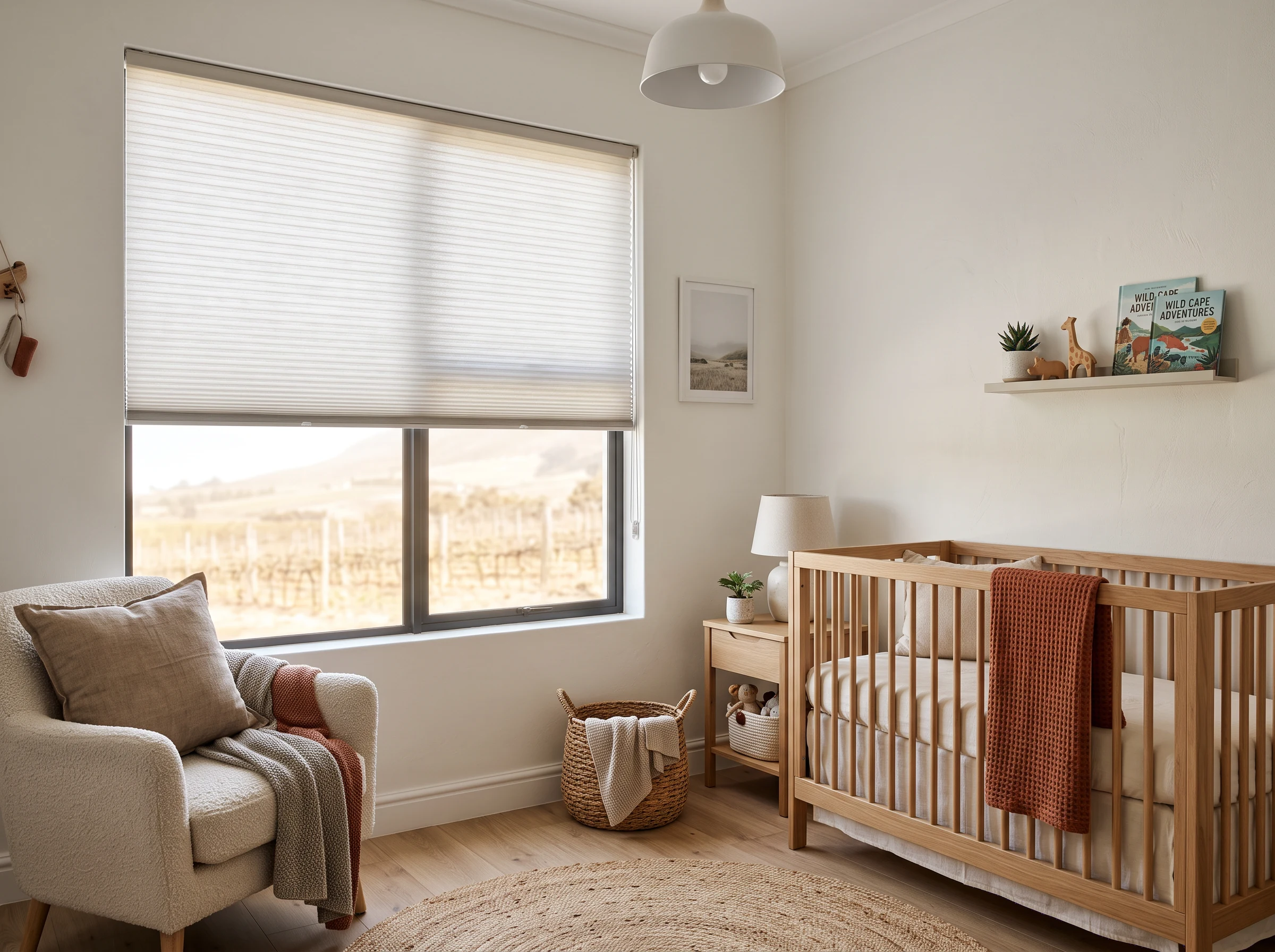
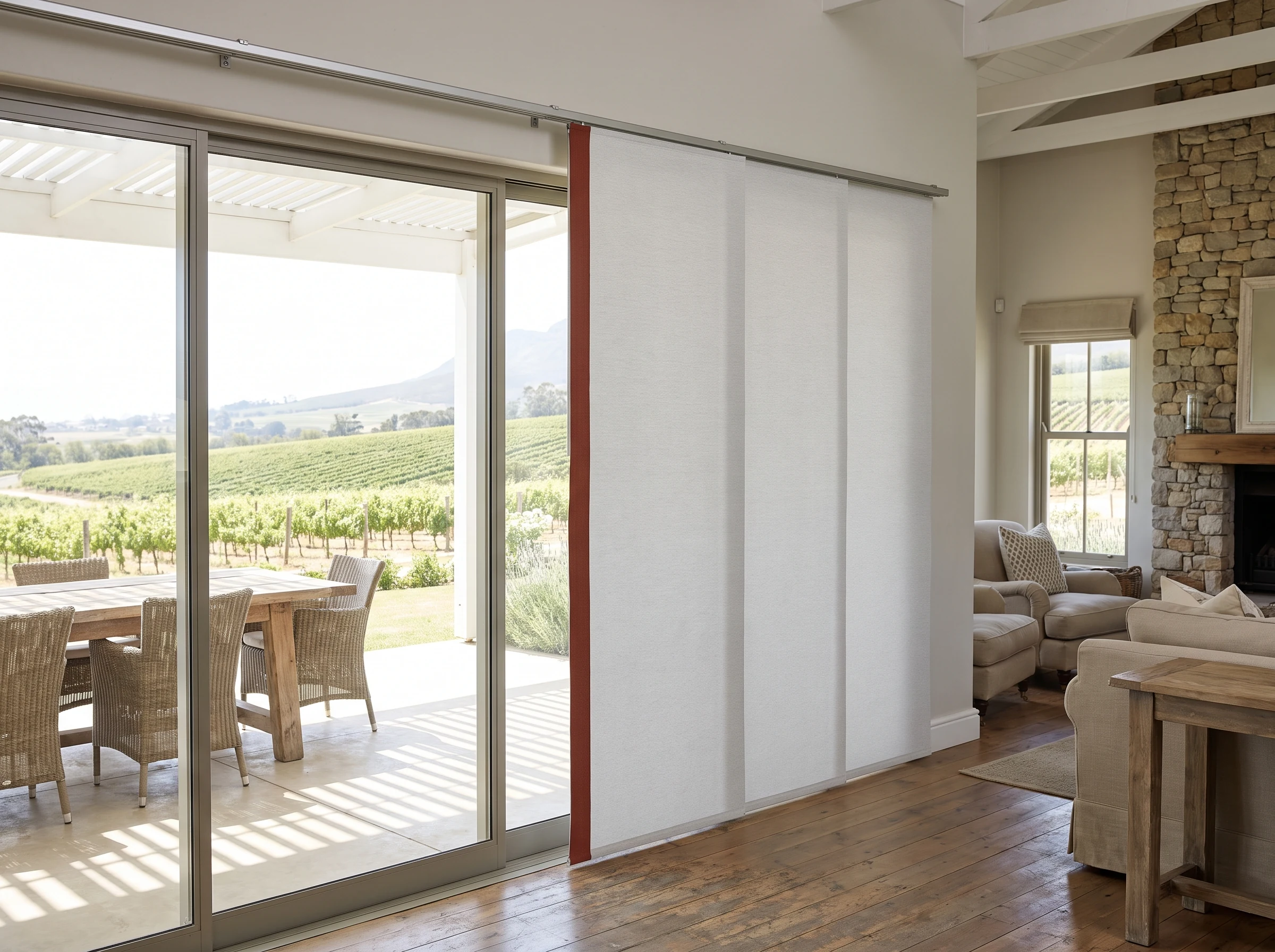
Deep in the Winelands a mountain decides half of what your windows do. Out at the crossroads it decides none of it. Here your aspect is the entire answer — so this guide walks a smallholding once round the outside, one wall at a time.
Short on time? Grab the PDF and come back to it — 11 pages.
Take a folding chair and walk right round your house. It takes four minutes and it will tell you more than any brochure ever printed.
The reason that works out here is that Klapmuts is not tucked into anything. The settlement stands where the R44 crosses the N1, beside Klapmutskop — the low, flat-crowned hill the old Dutch travellers nicknamed after a soft flat cap, which is how the place got its name.1 A hill of that shape and that modest height shelters very little. The Simonsberg is off in the distance doing scenery rather than shade. Between them and your walls lie vineyard blocks, cut lands and a great deal of sky.
Which strips the problem right down. Take away the ridge and one variable is left standing — and it is a variable you can read straight off a compass: which way each wall of your house is pointed. Get that part right and most of the shading specifies itself.
So: north wall, east wall, west wall, south wall, and then the direction nobody thinks to check, which is upward from the ground. Every number below is ordinary solar arithmetic for this latitude, and the workings are in the sources so you can repeat them for yourself.
Why Aspect Decides It Here
Two numbers set up everything that follows, and both fall out of sitting at roughly 33.8 degrees south.2
The first is how high the sun climbs at midday: about 80 degrees in late December, near enough overhead that a decent roof overhang drops its shadow almost vertically down the wall beneath it, and about 33 degrees in late June, low enough to reach across a room and warm the far wall. One overhang, two opposite jobs, both of them the ones you want, for no money and with no moving parts.
The second is where on the horizon the sun appears and disappears, and this is the figure that nobody checks. It rises due east and sets due west on exactly two days a year. In midsummer it comes up around bearing 119 degrees and goes down around 241 — both a long way south of the compass points you are picturing. In midwinter it comes up near 61 and drops near 299, both north of them.2 Over a year, the setting point slides through close to sixty degrees of horizon.
Keep those two in your head and start walking. First wall.
Wall one · the easy one
North: The Wall That Behaves Itself
In this hemisphere the north face is the well-mannered one, and that is worth knowing before you spend a rand on it.
At the top of summer, with the noon sun 80 degrees up, a north window is sitting in the shade of its own eave or stoep roof. In the depths of winter, with the sun crossing due north at 33 degrees, that same window collects sun for most of the day and hands the room heat you would otherwise be paying for. Nobody has to buy that behaviour. It is geometry, and the older buildings out this way have been quietly living off it since long before anyone used the word thermal in a sales conversation.
So the north elevation is where we most often advise spending less. Heavy permanent cover on a properly eaved north window fixes an eight-week irritation and charges you for the other forty-four.
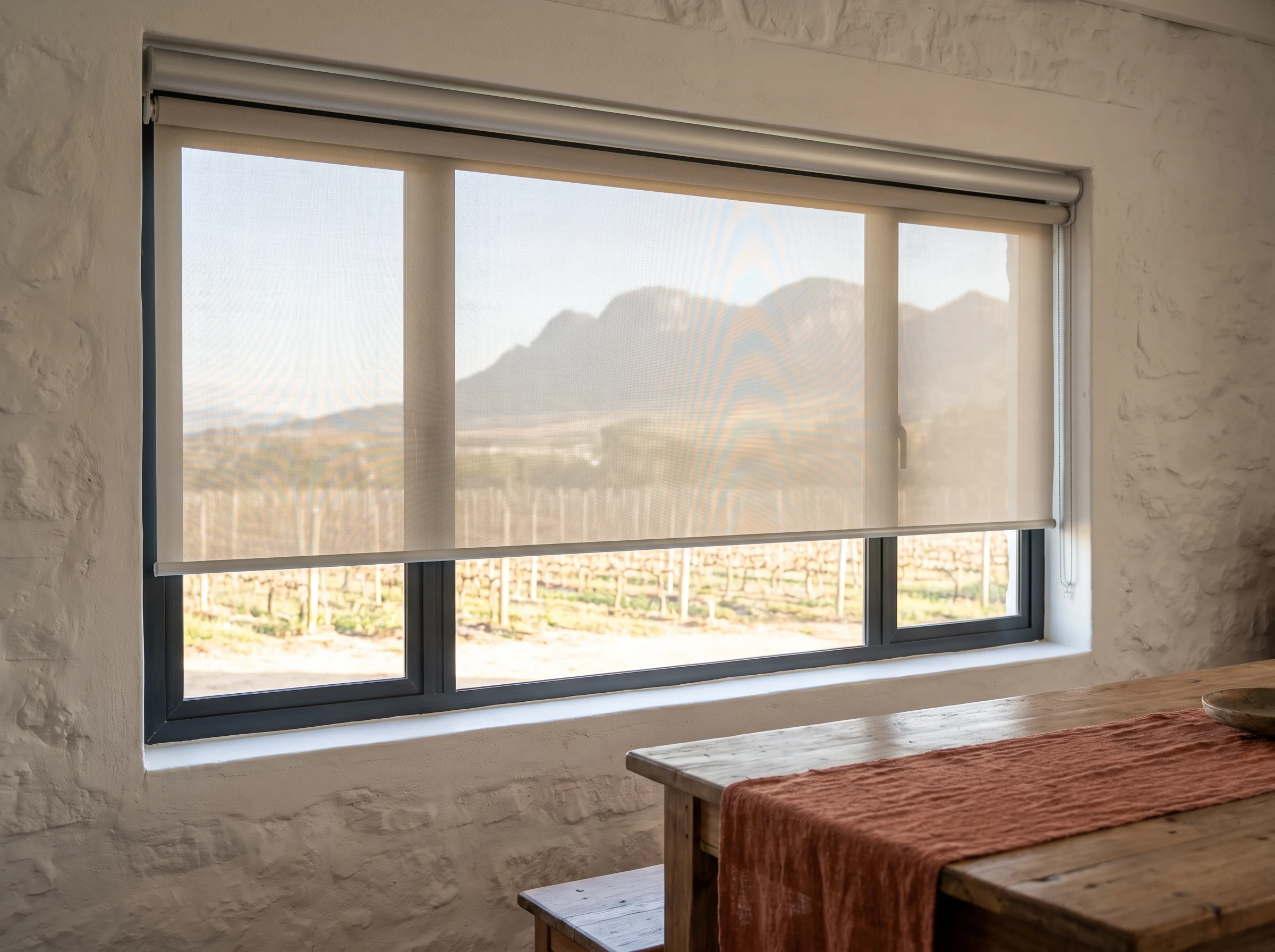
What usually belongs here: something adjustable, in a pale colour. A sunscreen mesh takes the sting out of light bouncing back off bright vineyard and gravel without dimming the room; a venetian gets you three settings from one product — flat open for winter warmth, tilted upward to throw daylight onto the ceiling, shut for privacy. If your north window has no overhang above it whatsoever, ignore this section and read the west one instead.
Mesh instead of blockout on a sheltered window: glare down, view and winter daylight untouched.Wall two · the early one
East: The Wall That Wakes The House
Turn the corner. In midsummer the sun clears the horizon on a bearing near 119 degrees, shortly after half past five in the morning, and it arrives at almost no angle at all — flat across open ground, with nothing at all standing between it and your bedroom.
An eave is powerless against that. Overhangs work on sun that comes from above; this is sun that comes from the side. So on the east wall the conversation stops being about heat and becomes about darkness — and about one specific misunderstanding we get called out to correct over and over.
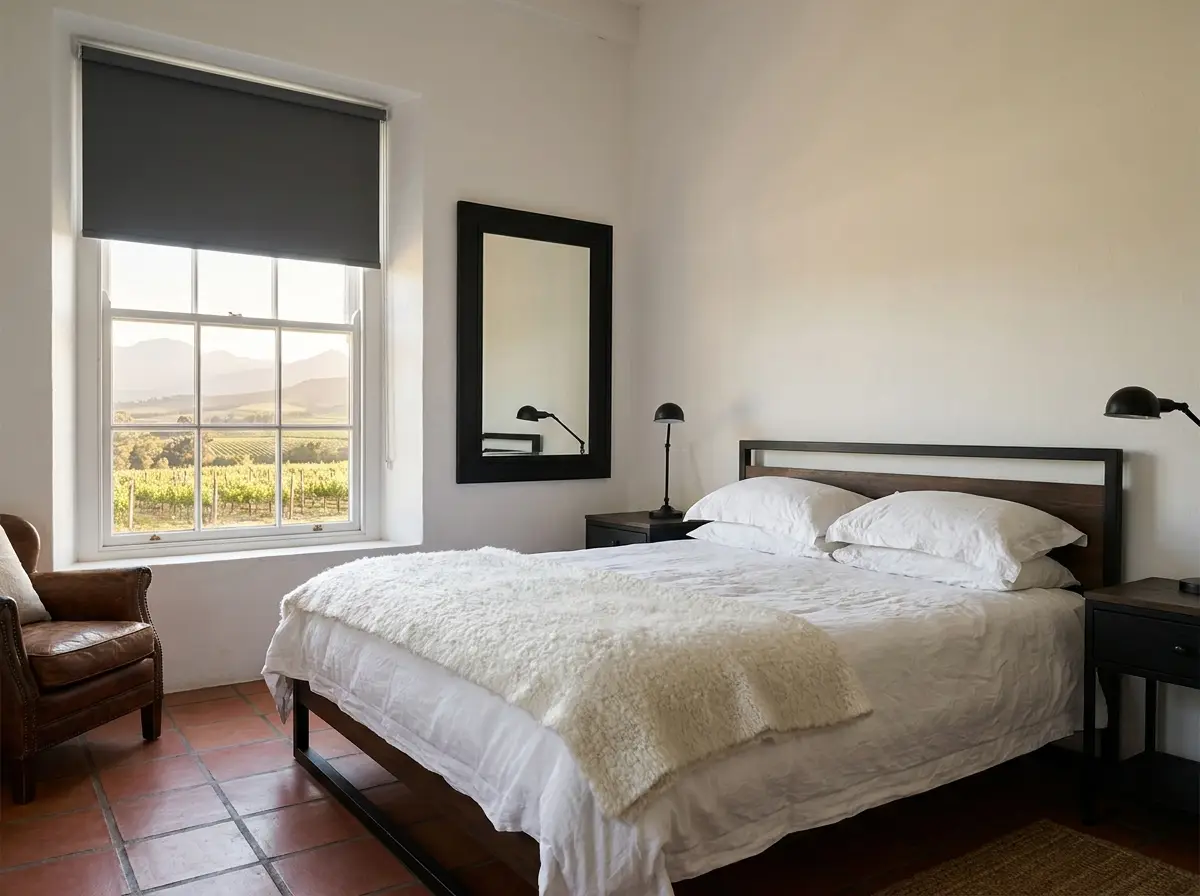
Every blockout fabric is opaque. Hold any of them up to a lamp and nothing gets through. So if a room is bright at six in the morning with the blind fully down, the light is not passing through the material. It is getting past it — down the two sides, over the top, under the bottom rail.
Inside the reveal looks tidy and shows off a good sash, and it leaves a bright seam down either edge. In a farm bedroom facing the sunrise, that seam is your alarm clock.
Over the opening — fixed to the wall face with real overlap above and to the sides — is the identical fabric in the identical colour and a very much darker room. It costs nothing extra. It is decided at the measure, in about thirty seconds, by where the brackets land.
Side channels push it further still, for a guest cottage, a nursery, or anybody working night shifts.
Worth being straight about: a room that has to be properly dark and a room that has to look elegant with the blind rolled up are pulling against each other. Over-mounting hides some of your joinery. We will hold the sample in both positions at the window and let you pick, rather than quietly choosing the prettier one for you.
Darkness is settled at the edges, never in the weave. Ask where the brackets are going before you ask about fabric.Wall three · the expensive one
West: The Wall That Costs You Money
Round again, and here is the one that matters. If you do something about a single elevation on a property out here, make it this one.
Three things pile up on the west wall in late summer, and they pile up together. The sun is low, so it comes in beneath every overhang you own. It is arriving late in the day, by which time the ground, the walls and the room have all been soaking up heat since morning. And its bearing has swung to roughly 241 degrees, noticeably south of west — so the elevation genuinely taking the punishment is frequently the corner between west and south, which is not the wall the owner has been complaining about.
This is also where interior blinds run out of road, and we would rather say that than sell around it. Sunlight that has crossed the pane is inside the room. Fabric hanging behind the glass soaks it up and returns a fair share of it to the air on your side. Glare, it will handle superbly. Temperature, it will not — not at any price and not in any colour.
The only shading that changes how hot a west room gets is shading that stands outside the glass. That is the entire reason our premium tier exists:
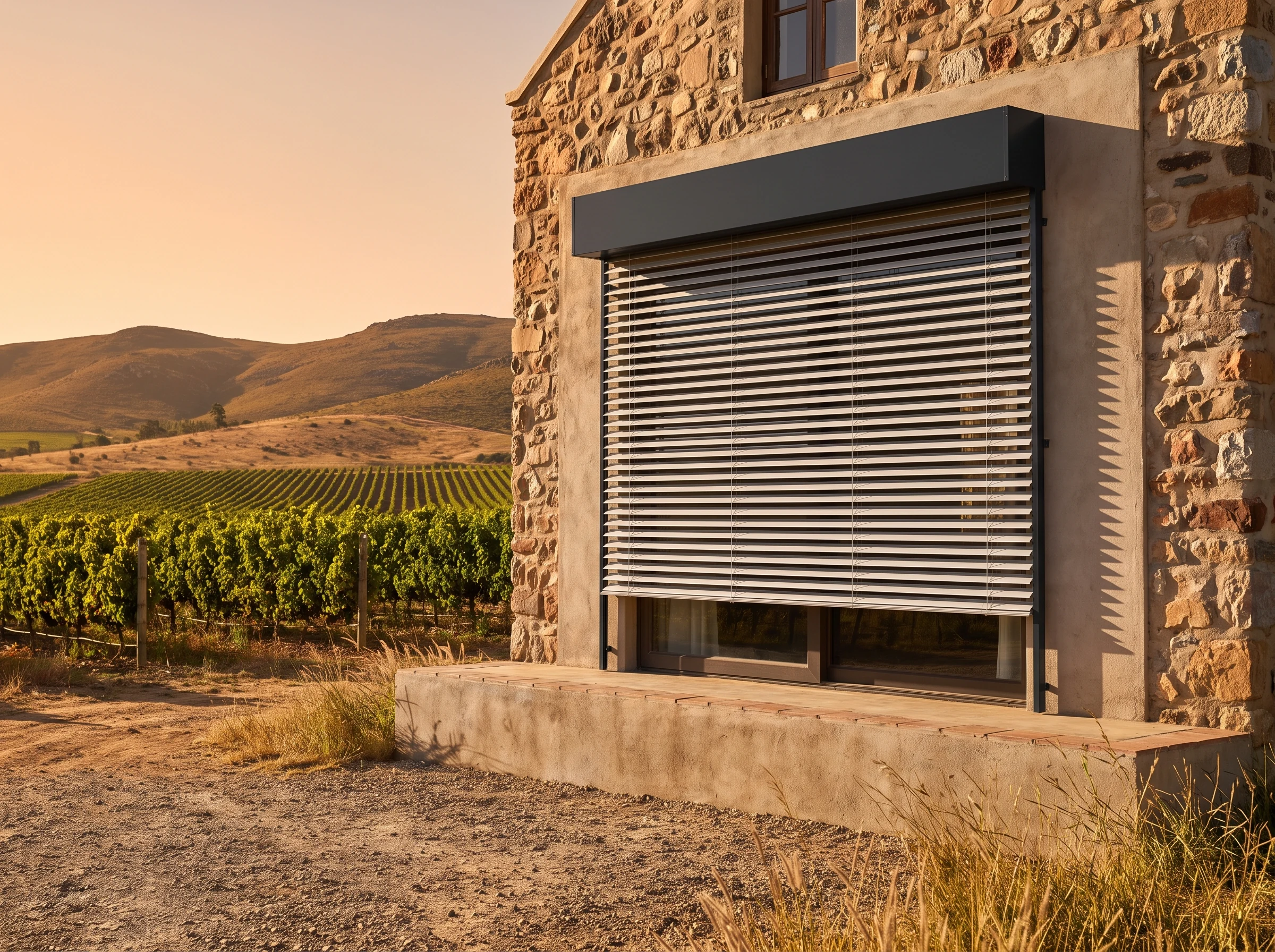
External venetian blinds. Aluminium blades carried on brackets clear of the window and tilting under motor control. Because they angle rather than merely drop, you can set them to cut a low sun and still look out between them — the glass is kept in shadow while the view survives the fix.
External shading shutters. A rigid aluminium curtain that comes down from a headbox and runs in side channels. It works by closing rather than by angling, so you trade the outlook for the most complete stop available. That is the sensible call on a bedroom nobody sits in after lunch, on a holiday cottage standing shut through midsummer, or on an elevation that is simply overwhelmed.
Zip screens where the west side of the house is a stoep or covered outdoor room rather than a pane of glass.
Two things we would rather you heard from us. External shading is the dearest tier we offer and it is a permanent fixture on the face of your building, so if there is an estate committee involved, ask them before you ask us. And a word about naming, because the terms get muddled: this is external shading hardware. Its job is sun, heat, brightness and daylight. It is not security-rated equipment, which is heavier and built for a different purpose entirely — should your real concern be break-ins rather than heat, tell us at the measure and we will say plainly that this product is the wrong one.
Standing clear of the pane, on the sun's side of the argument. A west elevation is only ever really won out here.Wall four · the quiet one
South: Even Light, Cold Room
The last wall is the one people write off, and they are half wrong about it.
All winter a south wall at this latitude gets no direct sun whatsoever — the sun never travels far enough round. In high summer it catches a little, but only in the first and last minutes of the day, when the rising and setting bearings swing south of the east–west line.2 The rest of the time it takes sky light: soft, indirect, and almost unnervingly consistent from hour to hour.
That makes it the best wall in the building for anything where steady light matters — a studio, an office full of screens, a workbench, any room where you need to judge a colour honestly. Covering it heavily is usually a waste.
Its actual problem is the reverse one. A south room with no sun on it through a wet Cape winter runs cold, and on a clear night the inner face of a single pane becomes the coldest surface in the room. That is where your heating leaves and where the moisture gathers.
What we would fit here: honeycomb cellular fabric. Its cells hold a pocket of motionless air right up against the glass, and motionless air is a poor conductor — the fabric is really just the thing keeping the pocket in place. Shut overnight, it raises the temperature of that inner pane. Its limits, stated plainly: no tilt, no scrubbing, and no good in a steamy kitchen or a scullery. Bedrooms and quiet rooms are where it earns its keep.
A cold south room is an insulation job, not a sun job — and the two want entirely different products.The fifth face
The Fifth Direction: Up Off The Ground
Here is the one that catches people out, and it is peculiar to properties shaped like these.
What reaches a window is not only the beam straight from the sun. It is also light scattered out of the sky, plus light thrown back up off whatever happens to be lying in front of the window. Solar modelling accounts for that third portion with a ground-reflectance figure, and the standard default for ordinary ground is about twenty per cent.3
Now picture what is actually out there in front of a smallholding window: a pale gravel turning circle, a limewashed werf wall, a stretch of ploughed sand, the roof of a steel shed, cut lands gone straw-coloured by January. Every one of those throws back more than plain lawn would. We have not measured it on any particular property, so treat the strength of it as an observation rather than a number — but it is unmistakable once you start looking, and it shows up as a room that is uncomfortably bright at eleven in the morning with the sun nowhere near that side of the house.
And an overhang cannot help you, because the light is coming from underneath it.
It shows up as brightness without warmth. A room that dazzles but does not cook is very often a ground-bounce room.
The remedy sits low on the window rather than high — which is precisely what a bottom-up blind, or a mesh drawn partway up from the sill, is built for.
Sometimes the cheapest fix is changing the ground: a planted strip, a darker paving choice, a low hedge on the bright side. That costs you nothing from us, and we would rather mention it than not.
Same compass, two answers
Two Building Eras On One Road
The compass is fixed. What is standing on it is not, and around this junction there are broadly two kinds of building sharing the same roads and the same sky.
The older farmhouse and the smallholding cottage
Thick walls, modest openings sunk well back into them, a stoep or a generous eave down the sunny side. Buildings like this turn up with much of the work already finished: a window set half a metre into a wall is shading itself through the middle of the day for nothing. The error here is buying a specification drawn up for a glass box and hanging it on a building that never needed one. Deep reveals suit slat products, which sit in them like joinery rather than like an add-on — and a fair number of rooms in an old cottage want nothing at all, which is a sentence we are perfectly happy to say out loud during a measure.
The newer estate and family home
Wide sliding and stacking doors, thin overhangs or none, glass sized for the outlook rather than for four o'clock. On these properties the west wall is a genuine engineering problem rather than a comfort niggle, and external shading stops being a luxury line on the quote. Interior fabric drawn across a six-metre opening changes how the room looks, not how hot it gets.
Where that lands: two properties with the same aspect and the same budget, one put up in the 1890s and one in the 2010s, should come back with visibly different quotes. If they do not, somebody has quoted off a template rather than off the building.
A wide modern opening with next to no overhang above it — pleasant to dress on the inside, but only solvable from the outside.
What A Plan Cannot Tell Us
All of the above you can work out yourself with a compass and a walk, and it is yours whether or not you ever contact us. What it will not settle is the handful of details that decide a real specification — and every one of them needs a person standing at the window:
The true bearing of each wall. Plans get drawn to grid north; houses get built square to the road. Take the reading at the glass.
How deep the reveal runs and what it is made of, which settles inside mount against over mount — and with it, how dark that east bedroom will really go.
Whether the head of the opening has real structure behind it to take the weight of external hardware, or only plaster over a closer. On a wide modern opening, that answer decides whether the best product is even available to you.
What is lying on the ground outside, and how much of the room's brightness is arriving from below the sill.
How much weather the stoep actually catches once the air picks up. Anything retractable out here is specified motorised with a wind sensor, because a screen that relies on somebody being home to remember it is a screen you will be replacing.
The measure costs nothing, the quote is written and itemised window by window, and neither one obliges you to buy anything. Where the honest answer is that a room is fine as it stands, that is the answer you will get.
Ready when you are
Walk it with us — four walls, one afternoon.
One of our expert consultants will contact you shortly to arrange a free in-home measure, with fabric and slat samples judged in your own light.
If you have done the walk, tell us which wall was worst and roughly what time of day. That one detail shortens the conversation more than anything else you could send.
POPIA notice: the details you submit are used only to arrange your free in-home measure and quote, and are never shared or sold to a third party.
References
Sources
Public and checkable. The solar figures are arithmetic you can repeat yourself, and where a statement above is our own observation rather than a published measurement, the sentence says so.
Wikipedia — Klapmuts, for the settlement's position at the R44/N1 junction, the hill it stands beside, and where the name came from.
Sun altitudes and bearings: computed, not quoted. Midday height is the latitude taken off a right angle and then shifted by the planet's 23.44-degree tilt, in whichever direction the season calls for. The rising and setting bearings follow from the declination and the latitude in the standard way, evaluated at both solstices. Worked at the latitude given in source 1; compare them against any published sun-path table, for instance timeanddate.com/sun.
Ground-reflected irradiance, and the customary default ground-reflectance assumption of 0.2, are documented in the US National Renewable Energy Laboratory's PVWatts methodology, which is public and free to inspect.
South-western Cape rainfall seasonality and summer heat — climate data and daily forecasts published by the South African Weather Service.
This page offers no opinion on estate approvals or building regulations. Those questions sit with your managing agent, your local authority and whoever drew your plans. The shading judgements are ours alone, given free and with nothing attached.